How Do You Bet on Baseball? A UK Punter’s Complete MLB Guide
 Available in US
Table of Contents
- Why MLB betting feels different to a UK punter
- The seven things to know before your first MLB bet
- The UK baseball betting market in numbers
- Is MLB betting legal in the UK?
- The five core MLB betting markets explained
- Reading MLB odds: fractional, decimal, American
- Price it, size it, grade it
- A worked first bet, from card to settlement
- Bankroll and unit sizing — the only maths that matters early
- Why the UK matters to MLB right now
- Five mistakes new MLB bettors make
- Staying in control: responsible gambling for MLB
- Where to go next on ChalkRunner
- Frequently asked questions
By MLB Betting Analyst · focused on run-line value, totals modelling and starting-pitcher matchups across UK-licensed sportsbooks, with 11 years covering Major League Baseball markets.

Why MLB betting feels different to a UK punter
The first MLB ticket I ever placed in London was a Yankees moneyline at 4/9, and I lost in the bottom of the ninth on a one-run flip. That game taught me something I have repeated for eleven years to anyone moving from football and the horses into baseball: MLB never gives you the draw, the favourite is rarely as safe as the price implies, and almost a third of all games come down to a single run. If you are used to backing Manchester City at 1/4 and feeling nailed on, you are about to have your priors rearranged.
Baseball does not behave like Premier League football or National Hunt racing. There is no draw, so the bookmaker prices a binary outcome and the run line, the sport’s standard handicap, is locked at 1.5 because close to 30% of all MLB regular-season games are decided by one run. That single fact, more than any other, is the reason MLB betting markets look the way they do. Pitching dominates a single game in a way no individual position dominates a football match, weather alters the physical flight of the ball every night, and 162 regular-season games per team mean the variance is immense. The list of things you need to learn is short, but each item matters more than its football equivalent.
The popularity case is also stronger than most British punters realise. Final MLB attendance for the 2025 season reached 71,409,421, a third consecutive year above 70 million for the first time since the 2015 to 2017 stretch. MLB.TV, the league’s streaming product, recorded 19.39 billion minutes of viewing in 2025, a 34% jump over 2024 and an outright consumption record. This is not a niche American curiosity any more, and UK bookmakers know it. They have widened markets, deepened props menus and started pricing London Series games like marquee fixtures.
This guide is built for a UK punter who has never placed an MLB bet, or who has dabbled and been burned by a -1.5 favourite that won by exactly one run. I will walk you through the five core markets, the three odds formats you will encounter on a UK slip, the maths behind sensible staking, and the regulatory backdrop that protects you when you bet through a UKGC-licensed operator. You will leave with a clean framework for your first bet and a reading list for whatever angle you want to dig into next.
71.4m
2025 MLB attendance — third straight year above 70 million.
+34%
MLB.TV viewing growth in 2025 — a new consumption record at 19.39 billion minutes.
~30%
Share of MLB regular-season games decided by exactly one run, the reason the run line is set at 1.5.
1.5
The standard run-line handicap on every MLB game, every night.
The seven things to know before your first MLB bet
- Five markets cover almost everything you will bet: moneyline, run line, totals, player props and futures.
- The run line is fixed at 1.5 because nearly 30% of MLB games are decided by one run.
- UK books accept fractional, decimal and American odds — learn to flip between them in seconds.
- Stake one to two percent of bankroll per bet; you need a 52.38% win rate just to break even at -110.
- UKGC licensing is non-negotiable — it gives you GAMSTOP, ADR and dispute protection that offshore sites cannot.
- Weather, parks and the starting pitcher move totals more than any other input on a baseball card.
The UK baseball betting market in numbers
I keep a habit my old mentor drilled into me: before you bet on a sport, look at the size and shape of the market you are betting into. It tells you who else is at the table. The British gambling market in the year to March 2025 reached a Gross Gambling Yield of £16.8 billion, up 7.3% year on year. That is a record and, more importantly, it is the pool from which MLB pricing on UK-licensed sites is drawn — bigger pool, sharper closing lines, tighter margins on the markets that move the most volume.
Online is now the dominant channel. Online gambling in Great Britain produced £7.8 billion in GGY in the same period, a rise of more than £900 million compared with the previous year. Remote Casino, Betting and Bingo, the segment your MLB bet sits inside, accounts for 46% of total UK GGY. The Gambling Commission’s chief executive Andrew Rhodes put it bluntly at his ICE 2025 World Regulatory Briefing: the British market has hit the highest GGY ever recorded, and the official statistics tell you everything about the shape of the country’s gambling activity. He also noted, in that same speech, that the sports menu UK operators offer is widening — basketball, NFL, cricket and other US-based sports are seeing real engagement growth, baseball included.
What “GGY” actually means. Gross Gambling Yield is the amount operators keep after paying out winnings. It is the closest proxy you have for how much British punters genuinely lose to the bookmaker over a given period. A growing GGY does not always mean more punters; sometimes it means existing punters are betting more, or more often.

The fiscal trail is just as instructive. UK Betting and Gaming receipts for the April to August 2025 window came to £1,786 million, £153 million higher than the same months a year earlier — a 9% rise. General Betting Duty alone reached £714 million in the 2024-25 financial year, the highest level since at least 2021-22. When I see numbers like that climbing, I read them as a signal that bookmakers have more cash to spend on better pricing, more markets and faster live trading on second-tier sports — and MLB sits squarely in that “second-tier” growth bucket from a UK perspective.
If you take one number from this section, take 46%. That is the share of UK gambling spend that runs through the same online betting and gaming category your MLB bet will live in. You are not in a niche corner of the market. You are in the largest single revenue channel the UKGC tracks.
The practical takeaway for an MLB bettor is encouraging. The infrastructure around your bet — payment rails, customer-protection rules, advertising standards, complaints procedures — is mature and well funded. The flip side is that the operators you bet against are sophisticated. You are not picking a corner-shop bookmaker who has not bothered to model a Tuesday night matchup at Fenway. You are betting against pricing teams who have the budgets the GGY numbers above let them afford.
Is MLB betting legal in the UK?
Short answer: yes, on every UKGC-licensed site, all year round. Long answer: the licensing decision is the single most consequential choice you make as an MLB bettor, far more than which moneyline you take on any given night. I have seen punters lose four-figure balances to offshore “VIP” sites that ignored a withdrawal request for six weeks — and have nowhere to go because they were not betting through a UK-licensed operator.
UKGC-licensed bookmakers are bound to pay out legitimate winnings, segregate customer funds from operating cash, offer self-exclusion through GAMSTOP, and route disputes through Alternative Dispute Resolution providers. The Commission backs that framework with enforcement teeth. Across April 2024 to April 2025 alone, the UKGC issued more than 770 cease-and-desist notices — 262 to operators, 205 to advertisers — and worked with Google to delist around 64,000 URLs pointing punters at unlicensed sites. That activity does not stop offshore operators existing, but it makes it harder for them to reach UK eyeballs through paid traffic.
How to verify a UK MLB site is licensed in 30 seconds. Scroll to the operator’s footer and look for a Gambling Commission account number. Plug that number into the UKGC public register search. If the operator is listed as active for “Remote casino, betting and bingo” your MLB bet is on the right rails. If you cannot find the number, or the licence shows revoked or suspended, walk away — even if the welcome offer looks unbeatable.
UK winnings on betting are not personally taxable. The Treasury collects from the operator side instead, which is why General Betting Duty alone produced £714 million for HMRC in 2024-25. You keep your full winnings; the bookmaker hands a share of the gross margin to the Exchequer. Andrew Rhodes flagged the broader US-sports trend explicitly in his ICE 2025 briefing: the league menu is widening at UK operators, with cricket, basketball, NFL and other US-based sports gaining usage. Baseball belongs on that list, and the regulatory regime treats it the same as a Premier League single — same dispute paths, same self-exclusion tools, same advertising rules.
If you want the full regulatory picture — the licence conditions, advertising rules, ADR routes and what happens when an operator gets it wrong — the deep treatment lives on our UK gambling regulation guide for MLB bettors. It is the longest read I will send you to in this article, and the most worth your time before you fund any account.
The five core MLB betting markets explained
You can build a perfectly viable MLB betting career on five markets. Three are non-negotiable: moneyline, run line, totals. The remaining two — props and futures — sit alongside as ways to express specific opinions when you have one. I will spend the rest of this section unpacking each, with worked numbers a UK punter actually sees on their slip.
Why five and not fifteen? Because the long-run data is not kind to recreational players who spread bets across exotic markets. MLB underdogs win roughly 44% of regular-season games — about four in every nine — which means there is plenty of edge in the simplest markets if you price them better than the bookmaker. Exotic correlated multiples and pitch-by-pitch micros can be fun, but they are not where new punters should fight their first battles.
Game-line markets
Moneyline, run line and totals all settle on the final score of a single nine-inning game. They are the bread and butter of MLB pricing, with the deepest liquidity and the tightest margins on UK sites. If you are starting out, this is where most of your action belongs.
Player and futures markets
Props focus on a single player’s performance over a single game; futures stretch across the entire season. They share one trait — wider margins for the bookmaker — but they exist on opposite ends of the time horizon, which changes how you size and hold them.

Moneyline — the simplest MLB bet
Pick the winner of the game. That is the entire market. There is no draw — if the game is tied after nine innings, extra innings decide it, and your moneyline ticket is alive until someone wins. The complication is the price. Because there is no draw to siphon probability away, MLB favourites are routinely shorter than UK punters expect.
Worked moneyline example
Yankees vs Red Sox, listed pitchers Cole vs Houck.
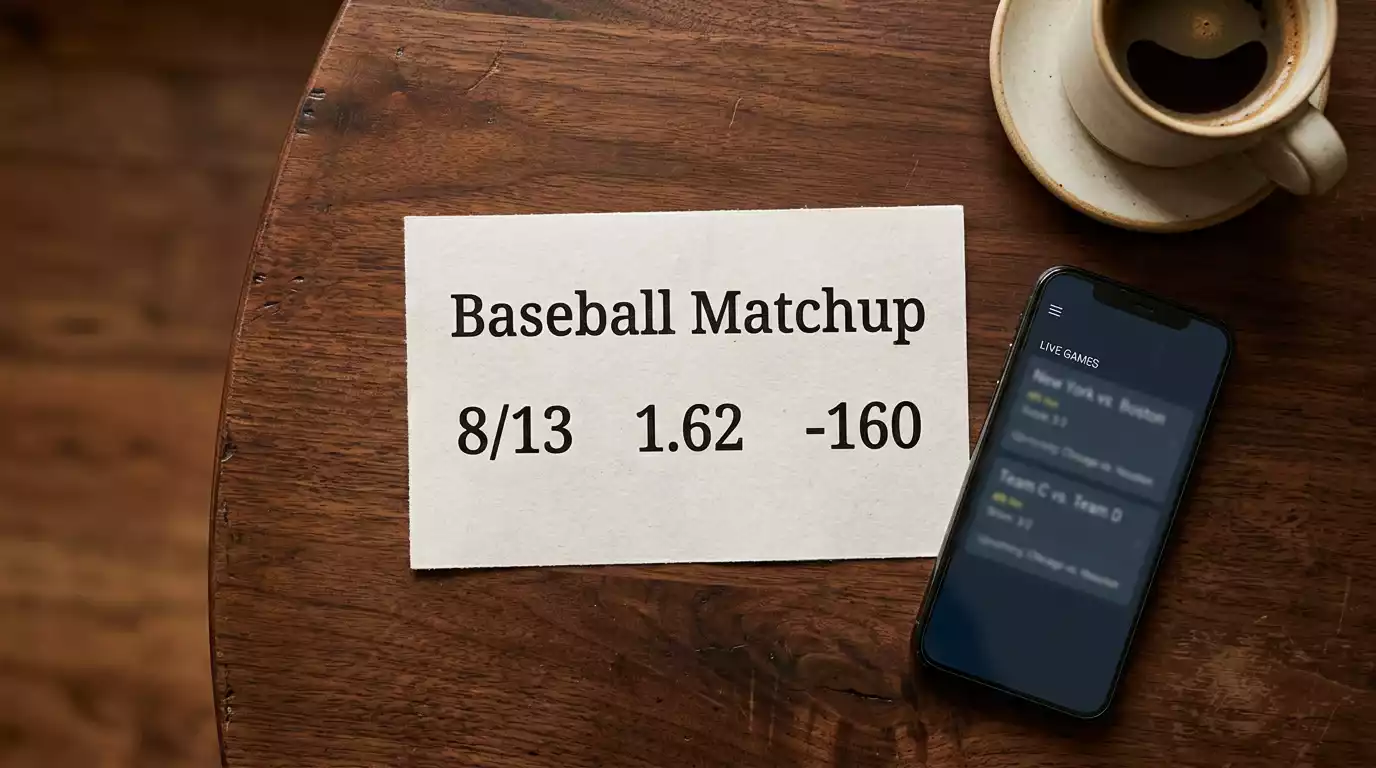
Yankees moneyline: 8/13 fractional, 1.62 decimal, -160 American.
Red Sox moneyline: 11/8 fractional, 2.38 decimal, +138 American.
A £10 stake on the Yankees returns £6.15 profit if they win. A £10 stake on the Red Sox returns £13.75 profit if they win. The combined implied probability of both prices is roughly 103%, with the 3% being the bookmaker’s margin.
The price tells you everything about market expectation but very little about value. An 8/13 favourite is priced as a roughly 62% winner once you strip the margin out. If your own model has the Yankees at 58% — say, because you rate the bullpen mismatch differently — you do not have a value bet, even though they are the “obvious” pick. This habit of thinking in implied probability is the single biggest leap from football betting to MLB betting.
Run line — the standardised 1.5 spread
The run line takes that lopsided moneyline price and turns it into something more even. The favourite must win by two or more runs to cover -1.5; the underdog covers +1.5 if they win outright or lose by exactly one run. Bookmakers do not move the spread to 1 or 2 because the underlying scoring distribution does not justify it: close to 30% of all MLB regular-season games are decided by exactly one run. That single-run cluster is what locks the line at 1.5.
Worked run-line example
Same game as above. Yankees -1.5 priced at 13/8 (2.625 decimal, +163 American). Red Sox +1.5 priced at 4/9 (1.44 decimal, -227 American).
A £10 stake on Yankees -1.5 returns £16.25 profit if Yankees win by 2+ runs. A £10 stake on Red Sox +1.5 returns £4.40 profit if Red Sox win or lose by exactly one run.
The run line is the market I send most beginners to once they have understood the moneyline, because it forces you to engage with how the team actually wins, not just whether it does. A 5-1 Yankees victory cashes -1.5; a 3-2 Yankees victory does not. To dive deeper — alternate run lines, the home-versus-road dog split, juice swings and cover-rate realities — read the dedicated breakdown of why every MLB run line is fixed at 1.5.
Totals — runs, not goals
Totals are over/under bets on the combined runs scored by both teams. Most MLB totals open between 7.5 and 9.5, with 8.5 by far the most common number. The market input list is longer than for football: starting pitchers, ballpark, weather, umpire, bullpen freshness. All five matter, all five are publicly knowable before first pitch.
Worked total example
Total set at 8.5. Over priced 10/11 (1.91 decimal, -110 American). Under priced 10/11.
A £10 stake on Over 8.5 wins £9.09 if 9 or more combined runs are scored. The same stake on Under 8.5 wins £9.09 if 8 or fewer combined runs are scored. There is no push — the half-run prevents it.
If totals interest you, this is the market I would tell you to specialise in. Weather and park factors are publicly knowable, the data exists, and most casual punters ignore both. The detailed guide on how weather, parks and pitching move MLB totals walks through the inputs in the order I use them on my own slips.
Player props and futures in brief
Player props ask a question about a single player’s performance: will pitcher X record over 5.5 strikeouts, will hitter Y get a hit, will the team’s first inning produce zero runs (the well-known NRFI market). Futures ask a question about the season: who wins the World Series, who wins MVP, who wins Cy Young.
Both markets share one important feature for new punters — the bookmaker’s margin is wider than on game lines. That is the price you pay for narrower outcomes (props) or longer holds (futures). I use them sparingly, only when I have a specific opinion the game line does not let me express, and I size them smaller than my standard unit. Treat them as the optional fifth course on the menu, not the main meal.
Reading MLB odds: fractional, decimal, American
The first time I tried to settle a +135 underdog ticket in my head while standing in a Soho pub, I miscounted my profit by a fiver. Three formats, one bet, and you will see all three on a UK MLB slip depending on which operator you use and which settings you have toggled. Learning to flip between them in seconds is non-negotiable.
Fractional is the British native: it tells you profit-per-unit-stake. 8/13 means stake £13 to win £8 profit. 13/8 means stake £8 to win £13 profit. Anything where the first number is bigger than the second is an underdog price; anything reversed is a favourite. Decimal odds tell you the total return per unit, profit plus stake combined: 1.62 means £1.62 back per £1 staked, of which £0.62 is profit. American odds, the format MLB sportsbooks were built around, work in two directions. A negative number tells you how much you must stake to win £100. A positive number tells you how much profit you make from a £100 stake.
Same bet, three formats
Yankees moneyline at fractional 8/13.
Decimal: 1.62.
American: -160.
Implied probability: 61.5%. Conversion rule: divide 1 by the decimal odds to get the implied probability before margin. 1 ÷ 1.62 = 0.617, or roughly 62%.
The 30-second conversion shortcuts I actually use. Fractional to decimal: divide the fraction and add 1. So 8/13 = 0.615 + 1 = 1.615. Decimal to American positive: subtract 1, multiply by 100. So decimal 2.50 = +150. Decimal to American negative: divide -100 by (decimal – 1). So decimal 1.62 = -100 ÷ 0.62 = -161, which rounds to -160. None of these need a calculator after the first week.
Why does the format matter for an MLB bettor specifically? Because the prices you read in match previews, podcasts and US analysis sites will overwhelmingly be in American format, while the prices on your UK slip will default to fractional. If you cannot translate “Cole -160” into “8/13” on instinct, you cannot tell whether the UK price you are about to take is sharp or shaved relative to the consensus US line. The bookmakers know this. They also know that less confident punters tend to look at fractions and accept what they see, while sharper punters compare to the American consensus. Speed of conversion is, in itself, a small edge.
Implied probability is where the three formats become genuinely useful, because that is the language of value. If a price is offered at 8/13, decimal 1.62, American -160, the implied probability is 1 ÷ 1.62 = 61.5% before bookmaker margin. If your own assessment of the Yankees winning is 65%, you have a value bet at this price; if it is 55%, you do not, no matter how good the team looks on paper. Train yourself to read prices in implied probability and the rest of the maths in this guide will fall into place.
Price it, size it, grade it
A worked first bet, from card to settlement
Let me walk you through the bet I would actually place if you handed me £100 right now and told me to find a Tuesday-night MLB game I liked. I will use a generic example so the maths is clear, but the workflow is exactly what I run for myself before every bet I make.
You open the day's MLB card on your UK-licensed app. Twelve games, scattered across afternoon to late-night British time. You are not chasing every one. You scroll for a game where one starting pitcher has clear advantages — better strikeout rate, fresh rotation slot, favourable park, friendly weather. Say you settle on a National League matchup, listed pitchers confirmed, total opened at 8.5, run line as standard.
The card you are looking at
Home team moneyline: 8/15 (1.53 decimal).
Away team moneyline: 7/4 (2.75 decimal).
Home -1.5 run line: 21/20 (2.05 decimal).
Away +1.5 run line: 4/5 (1.80 decimal).
Total over 8.5: 5/6 (1.83 decimal).
Total under 8.5: 10/11 (1.91 decimal).
You have £100 of bankroll. Your unit size is 1.5%, which is £1.50. You decide the home favourite at 8/15 implies a 65% probability and your own model has them at 68%, so there is value. You also like the under at 8.5 because the weather forecast shows a strong inbound wind at a hitter-friendly park, and the umpire scorecard you trust gives this plate ump a tight zone that helps starters. You consider both bets but pick the run line single instead of doubling up — Home -1.5 at 21/20 — because it expresses the same opinion (this team wins comfortably) at a price that pays out 2x your stake, and you are more confident in the margin of victory than the under.
You stake £1.50 at 21/20. Potential return is £3.075. You note the bet in a tracker — date, sport, market, line, stake, odds, my model probability, bookmaker implied probability, the reasoning in two short sentences. The home team wins 5-2. Your bet cashes. £1.50 stake returns £1.575 profit. Bankroll is now £101.575.
The boring discovery from year one of tracking: the bet I get most excited about is rarely the bet that pays the rent. Variance dominates short-term outcomes in MLB. Process — sizing, line shopping, sticking to the markets you have actually studied — is what compounds.
That whole sequence — pick a game, identify two viable angles, choose the one with better price-to-confidence, stake to a fixed unit, log the rationale — takes me about eight minutes per bet now. Early on it took me thirty. The eight minutes is the entire job. Everything else in the rest of this guide exists to make that eight-minute decision better than it would otherwise be.
Bankroll and unit sizing — the only maths that matters early
I have watched more clever, well-read MLB bettors blow up over a single weekend than I can count. Almost none of them lost because they could not read a stat sheet. They lost because they staked 10% of their bankroll on a single Sunday slate, ran into the variance you would expect from a 162-game sport, and never recovered. The maths in this section is not glamorous, but it is the difference between betting MLB for a season and betting MLB for a week.
Start with the threshold. Against the standard bookmaker margin of -110 (10/11 in fractional), a bettor's break-even win rate is 52.38%. Hit that exactly and you are flat. Hit 54% over a meaningful sample and you are profitable. Hit 50% and you are losing money to the margin every time you bet. Almost nobody coming to MLB for the first time runs a 54% win rate from week one. Pretending otherwise is how bankrolls vanish.
Professional sports bettors typically wager between 1% and 2% of bankroll on a single bet, treating each as a "unit". For a £500 starting bankroll that is a £5 to £10 unit. Tedious? Absolutely. The point is to make any individual bet small enough that a bad night cannot bury you and to keep your unit large enough that a good run is meaningful. The veteran handicapper Jerald, writing for Predictem, frames it the way I frame it for myself: implementing good money management is almost as important as picking winners. The longer I have done this, the more I have come to believe the "almost" is generous to picking winners.
Before you tap "Place Bet" on an MLB ticket
- Listed pitchers confirmed and not under late scratch risk.
- Weather (wind direction, temperature) checked against the total.
- Bullpen workload over the last three days noted.
- Price compared across at least two UK-licensed books.
- Stake equals one to two percent of current bankroll, not your peak bankroll.
- Reasoning written down in one sentence in your tracker.
- If your reasoning is "I have a feeling about this one", stop.

Two pieces of jargon worth knowing before you go further. Flat staking means every bet is the same size — the same unit — regardless of how confident you are. Fractional staking means scaling unit size to your edge, usually via a fraction of the Kelly Criterion. Flat staking is the right starting point. It is boring, it is robust, and it stops you from sizing up on bets you "know" are winners. Once you have a documented edge across hundreds of bets, you can start exploring fractional staking. Not before. The deeper treatment of unit sizing, Kelly, variance and how to survive a 1-in-20 drawdown lives on our MLB bankroll management guide, which is the article I would tell you to read before any other on this site.
One framing that keeps me honest: think of your bankroll as a tool, not a balance. The number is allowed to go down. It will go down. What matters is whether your unit-sizing keeps the worst stretch survivable.
Why the UK matters to MLB right now
Two summers ago I had three London Series tickets to give away on a podcast and the inbox filled in 12 minutes. Five years before that, the same offer would have produced two replies. Something has shifted, and it is not just MLB executives saying so for a press release. The numbers behind British MLB demand have outgrown the "novelty curiosity" framing entirely.
Take the 2024 London Series, Mets versus Phillies. The two-game weekend generated an estimated £67 million economic boost for the city. Average attendance at the series reached 55,000 per game. Roughly 71% of those attendees came from the UK rather than visiting Americans, which is the figure that should change how you think about the British MLB audience. This is not a touring American crowd. It is a domestic British baseball-watching public big enough to fill an Olympic stadium twice in a weekend.
★ The very first London Series in 2019 sold out 120,000 tickets in under an hour. That single sales window is, quietly, one of the largest demand signals MLB has ever recorded outside North America.

MLB's executives have been blunt about what that means. Chris Marinak, the league's Chief Operations and Strategy Officer, told the Associated Press in 2024 that the UK is a priority market and an area MLB plans to emphasise for international growth. Commissioner Rob Manfred, speaking at a Mexico City press conference in April 2026, was even more direct: the league is interested in expansion if global broadcasters add up, and there are other markets for baseball beyond North America. Read those two statements together and you understand why UK bookmakers have been quietly widening their MLB markets, deepening prop menus and pricing London Series fixtures with the seriousness they used to reserve for NFL marquee games.
For you as a UK punter, three things follow. Liquidity around UK-relevant fixtures (London Series, opening day, post-season) will keep tightening, which is good for prices. Promo activity will keep arriving in waves around those weekends. And the British MLB knowledge base — podcasts, Twitter accounts, beat writers covering teams from London — will keep growing, giving you cheaper access to good information. The full treatment of the bookmaker shift, the broadcasting picture and what to look for around London Series weekends lives on our MLB betting in the UK guide.
Five mistakes new MLB bettors make
I have an unscientific theory: the best teacher in MLB betting is the bet you wish you could un-place. After eleven years I still keep a spreadsheet labelled "What I Did Wrong" with my worst ten bets per season. The same five mistakes account for roughly 90% of new-bettor losses I see. Here they are, in the order I usually see them happen.
Backing the obvious favourite every night. Heavy MLB favourites get priced steeply because the market knows they win more often. If you stake £20 to win £8 on a string of -250 favourites, you need to win nearly 71% just to break even. A run of bad luck across one bad pitching matchup and a freak bullpen meltdown can put you at -£60 in a week, and the maths to climb back is brutal.
Ignoring the starting pitcher. Football has 11 players plus subs and managers; MLB has one starter who throws roughly half the team's pitches on a given night. New bettors look at team form and miss that the team's ace is on the mound today and the team's fifth starter pitches tomorrow. The price reflects this; your reasoning often does not. Read the starter line first, the team line second.
✓ Do
- Stake the same unit size on every bet for at least the first three months.
- Confirm starting pitchers before you place any game-line bet.
- Compare the price across at least two UK-licensed sites.
- Track every bet with the reasoning, not just the outcome.
- Take a one-week break after a losing month to reset.
✗ Don't
- Chase losses by doubling stake on the next bet.
- Bet every game on the slate. Discipline is selectivity.
- Build six-leg parlays "for fun" with serious money.
- Place bets after midnight on second pints. The data on this is brutal.
- Move bookmakers chasing better welcome offers and lose your tracking continuity.
Parlay spam. The fastest way to convert a positive-EV bankroll into a negative one is stacking three to five MLB legs into a multi every night. The bookmaker's margin compounds across legs. Even if each individual bet is a slight overlay, the multi rarely is.
Unit creep. You go on a winning run. Suddenly £5 a bet feels small. You raise to £10. Then £20 feels right because you are "playing with house money". The bankroll-tracking truth is uncomfortable: even at a 55% win rate, with disciplined flat staking, your bankroll only reaches a new all-time high on roughly 5% of days. Most days, by definition, you will be below your peak. Do not let a hot week trick you into raising stakes on the back of variance you have not yet earned the right to own.
Bet first, research later. The bet should be the conclusion of the work, not the trigger for it. If you find yourself hunting for justifications after you have already tapped Place Bet, you have inverted the workflow.
Staying in control: responsible gambling for MLB
The honest truth I have learned about myself across eleven years: I am a happier, sharper bettor when I bet less than I think I want to. MLB makes this harder than most sports, because the season runs 162 games per team and there is always another game tonight. The volume itself is a risk factor.
The British data backs that up. Approximately 2.7% of GB adults experienced problem gambling in 2024, a level statistically stable with 2023, equating to roughly 1.4 million adults. The Gambling Survey for Great Britain's Wave 3 in late 2025 also found that 42% of those who had gambled in the last 12 months felt positive about their last gambling experience and a further 35% felt neutral. Most British gambling, in other words, is genuinely recreational. A meaningful minority is not, and the only person reliably positioned to spot the shift is you.
If betting on MLB stops feeling like part of watching the sport and starts feeling like the only reason you are watching the sport, that is the signal. Not a losing month. Not a single bad bet. The shift in why you turn the game on.
Andrew Rhodes, speaking on the publication of the GSGB findings in October 2025, captured the framing better than most: this year's findings deepen our understanding of consequences from gambling and provide crucial insight into risk profiles among those who gamble most frequently. He encouraged operators to use that evidence to consider risks within their own customer bases. As a punter, you can do the same exercise on yourself. UKGC-licensed sites are required to offer deposit limits, time-out tools, reality checks and full self-exclusion via GAMSTOP. Set the limits before you need them.
If MLB betting starts feeling compulsive rather than considered, GAMSTOP is the one-stop UK self-exclusion route across every UKGC-licensed operator at once. Sign up once and every UKGC-licensed site you have an account with locks you out for the period you choose. Operator-level cooling-off tools sit alongside it, and BeGambleAware and GamCare are the helplines worth saving in your phone before you ever feel you need them.
Where to go next on ChalkRunner
If you have read this far, you have the framework. The next step is depth on whichever piece of the puzzle matters most for the way you want to bet. Five paths sit on this site, and I would pick based on temperament rather than complexity.
If you want to be the bettor who knows why a -1.5 line moves half a cent on a Tuesday afternoon, the run-line guide is the first stop. If you find yourself drawn to numbers, weather data and the physics of fly balls, totals strategy is your home — that is the deepest analytical rabbit hole in the sport, and the one where public-facing data still gives a careful punter a real edge. If you want to make sure you survive long enough to find your edge in the first place, bankroll management is the dullest read of the five and the most important.
The UK-context guide is the article I would recommend if your interest in MLB is partly cultural — you went to a London Series game, you have a friend who flew over for opening day, you want to understand why the British baseball audience matters now. The regulation guide is the article I send to anyone before they fund their first betting account, because it answers the questions you should ask before taking any bookmaker offer.
Beyond those five core pieces, the cluster catalogue covers everything from starting-pitcher handicapping and FIP/xFIP fundamentals to umpire impact, NRFI markets, line shopping and the full pre-bet checklist. Pick the one that solves the problem you are actually facing tonight.
Frequently asked questions
What is the simplest way to bet on baseball?
The moneyline. You pick the team you think will win the game, full stop. There is no draw to worry about — if the score is tied after nine innings, extra innings decide the game, and your moneyline ticket is alive until someone wins. The price tells you the implied probability: shorter prices mean the bookmaker thinks the favourite is more likely to win. The trap to avoid is treating short-priced favourites as automatic value. A 1/4 favourite is implying an 80% win probability before margin, and MLB is variable enough that genuinely 80%-likely outcomes are rarer than you would think. Start on moneyline, but learn to think in implied probability before you scale up.
What is a run line in MLB betting?
A run line is the standardised handicap unique to baseball. The favourite is set at -1.5 and must win by two or more runs to cover; the underdog is set at +1.5 and covers if they win outright or lose by exactly one run. The line is fixed at 1.5 across every MLB game because close to 30% of all games are decided by exactly one run, which means the half-run cluster around the result is where the real action is priced. Bookmakers do not offer 1 or 2 because the underlying scoring distribution does not support a more granular line. If you take -1.5, a 5-2 win cashes; a 3-2 win does not.
How do baseball odds work in the UK if I'm used to fractional?
Most UK MLB sites display fractional by default. 8/13 means stake £13 to win £8 profit. 13/8 means stake £8 to win £13 profit. To translate to decimal — divide the fraction and add 1, so 8/13 becomes 1.62. To translate to American — under 2.0 decimal subtract 1 and divide -100 by the result, over 2.0 subtract 1 and multiply by 100. The reason to learn all three is that almost every podcast, preview and US analyst speaks in American format, while your slip speaks in fractional. Holding the conversion in your head means you can compare a UK price against the broader US consensus on instinct, which is a small but real edge.
What does First 5 Innings mean?
First 5 Innings, abbreviated F5, is a bet on the score after the top of the fifth inning is complete. The market exists because the first half of an MLB game is dominated by the starting pitchers, who throw the bulk of those innings. F5 lets you bet a pitcher matchup directly, without bullpen risk. If you think one starter outclasses the other but worry the trailing team's bullpen is fresh enough to come back later, F5 is the cleaner expression of your view. Markets include F5 moneyline (three-way, with a tie option), F5 run line at -0.5 / +0.5, and F5 totals (typically 4 to 5 runs).
Is MLB betting legal in the UK?
Yes, on every UKGC-licensed site. The Gambling Commission regulates online betting in Great Britain and licensed operators must offer customer-fund segregation, GAMSTOP self-exclusion, dispute resolution through ADR providers, and adherence to advertising codes. There is no UK-specific MLB exemption — it is treated like any other sport on the menu. UK winnings on betting are not personally taxable; the operator pays General Betting Duty to HMRC instead, and you keep the full payout. Where punters get into trouble is using offshore sites that look slick but operate outside UKGC oversight; those sites are the ones the Commission targets with cease-and-desist activity, and you have far fewer protections if something goes wrong.
How much should I stake on a baseball bet as a beginner?
One to two percent of your current bankroll per single bet. If your starting bankroll is £500, that is £5 to £10 per bet. Use flat staking — same size every bet — for at least your first three months, regardless of how confident you feel. You need a 52.38% win rate just to break even at the standard -110 margin, and almost nobody runs a profitable win rate from week one. The point of small flat units is to make any individual loss survivable while keeping your unit size meaningful enough that a winning streak compounds. Recalculate your unit size monthly, not after every winning bet.
What happens to my run line bet if a game is rain-shortened?
It depends on how many innings were completed. The MLB rule defining an "official game" is five completed innings (or 4½ if the home team is leading). For betting, most UK operators settle game-line markets — including the run line and total — only if the full game has gone to a defined point, often 8.5 innings or the home team leading after the top of the ninth. If the game is called short of that threshold, the run line bet is typically voided and your stake refunded, but settlement rules differ across UK books. Always check the specific operator's MLB rules tab before placing the bet, because two sites can settle the same rain-shortened game differently.
Created by the ”how do you bet Baseball” editorial team.